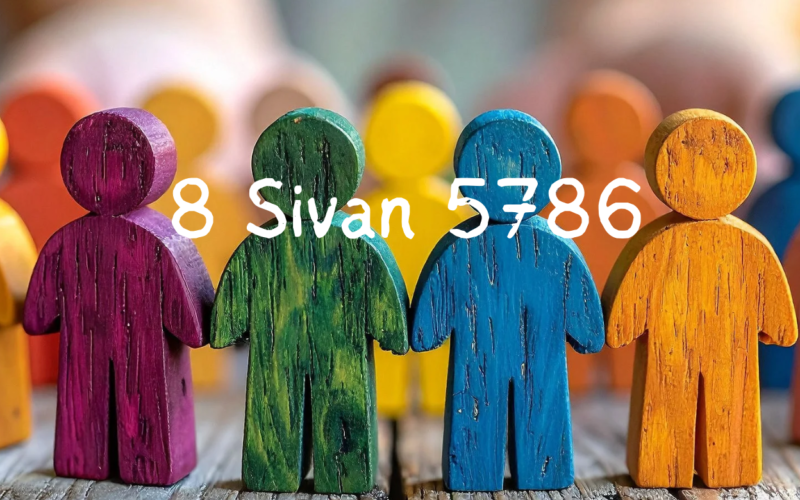
Where You Go, I Will Go: Ruth and the Power of Chosen Family
I was asked to give the d’var Torah at this morning’s Shabbat services and I focused on the book of Ruth.
“Where you go, I will go. Where you lodge, I will lodge. Your people shall be my people and your God my God.”
When you hear this classic passage from the book of Ruth, what comes to mind? Please feel free to call out your answers.
[Pause for audience responses and share a few]
I always think of conversion when I hear this passage. In fact, invitations I sent out for my own conversion ceremony over 13 years ago included this. I can also see how these words could be taken in a romantic context. But they were not originally exchanged between two people in love or spoken by someone formally entering Judaism. They were spoken by one grieving widow to another, as they stood on a dusty road between Moab and Bethlehem carrying uncertainty, heartbreak, and loss into an unknown future.
The book of Ruth begins with rupture. Naomi loses her husband and then both of her sons. Ruth, Naomi’s daughter-in-law, loses not only her husband, but the future she had envisioned for herself. Back in those times, widowhood was not just emotionally devastating, but it also brought economic and social vulnerability. They were each trying to figure out how they were going to survive.
So, Naomi tells Ruth and Orpah, her other daughter-in-law, to leave.”Go back,” she says. “Return to your mothers’ homes.”
Naomi assumes that because her sons, their husbands, have died, the bonds between them, legal and otherwise, are irrevocably broken. Ruth and Orpah no longer have any obligation to her. Orpah heeds Naomi’s words and leaves; Ruth chooses to stay.
But why didn’t she go? Her husband and the future she once saw was gone; she could have gone back home, to a familiar place, to her family, to rebuild. It would have been the easy road to take. But Ruth decides against this and in doing so, chooses her own family. It was, and in some ways still is, a radical idea.
Ruth chooses Naomi not because she has to, but because she wants to. She chooses loyalty over convenience, relationship over self-preservation, a shared destiny over separation. And perhaps that is what makes her declaration so powerful. Ruth’s commitment is not rooted in blood, inheritance, or obligation. It is rooted in love, covenant, and belonging.
One of the things that attracted me to Judaism was the emphasis on family. Having grown up as an only child of a single mom, the idea of a global family very much appealed to me. Ruth reminds us that family in Judaism has never only been biological.
From the beginning, Jewish identity has also been shaped by people who attached themselves to the Jewish story through relationship, commitment, and shared purpose.
Ruth enters the Jewish people not through conquest or coercion, but through connection. She walks beside Naomi. She gleans in the fields. She learns the rhythms of a new community. She builds belonging through acts of care and presence.
The community eventually embraces her and this woman who arrived as an outsider becomes the ancestor of King David. Jewish history itself emerges from this act of chosen connection.
Many people today have complicated relationships with their blood family. Some are distant or have experienced rejection or estrangement. Some build lives far from where they were raised. Others not only lean on their biological family, but also have friends, mentors, neighbors, and communities who become family in every way that matters.
Chosen family is not lesser family. Sometimes it is the family that saves us.
When my mom died in 2023, I was left an orphan, but I was not alone. The connections and friendships I began cultivating in 2011 at the beginning of my conversion journey blossomed into a powerful support network that sustained me and literally kept me alive during the most devastating time of my life. And this same community has embraced my little family, Stephen, Tinnin, Oliver, and Eliza, into the fold. We all make up this sacred space called Temple that makes it possible for us to have multiple Jewish mothers, fathers, and siblings.
One of the remarkable things about the Book of Ruth is that it does not end simply with private loyalty between two people. Ruth and Naomi survive because personal devotion becomes communal responsibility. This leads to Boaz noticing Ruth gleaning in the fields and responding not with suspicion, but with kindness and dignity. The community witnesses their restoration and ultimately celebrates it.
The Book of Ruth teaches us that holiness is not found only in dramatic miracles or grand public moments. It is found in ordinary acts of showing up for one another: walking beside someone in grief, bringing food, checking in, making space at the table, refusing to let someone carry pain alone.
Maybe that is part of why we read Ruth on Shavuot. Shavuot is the holiday of covenant and revelation, but Ruth reminds us that covenant is not only about standing at Sinai. It is also about the daily decision to bind ourselves to one another through love, responsibility, and care.
Ruth chooses Naomi. Boaz chooses generosity. The community chooses inclusion.
Again and again, the story asks us: What kind of people are we willing to become for one another?
In a world that can often feel isolating and fractured, Ruth offers us a different vision. A vision where belonging can be built. Where outsiders can become insiders. Where family is something larger and more expansive than biology alone.
And perhaps the deepest lesson of Ruth is that sometimes the people who transform our lives are not the ones we were born to, but the ones who walk beside us when the road becomes difficult.
May we all have the courage of Ruth: to choose connection, loyalty, and compassion.
And may we continue building communities where no one has to walk the road alone.
Shabbat Shalom.
No other words can express the beauty of yours. Love your words, and love you.